Your Brain Is Lying to You Right Now — And It's Doing It Out of Love

```html
Your Brain Is Lying to You Right Now — And It's Doing It Out of Love
You watched something on a screen this morning — a video, a reel, someone gesturing on a call — and you thought you were just looking at it. You weren't. Your brain was quietly doing something far stranger, and far more intimate, than simple seeing. It was feeling what it saw. And you had absolutely no idea.
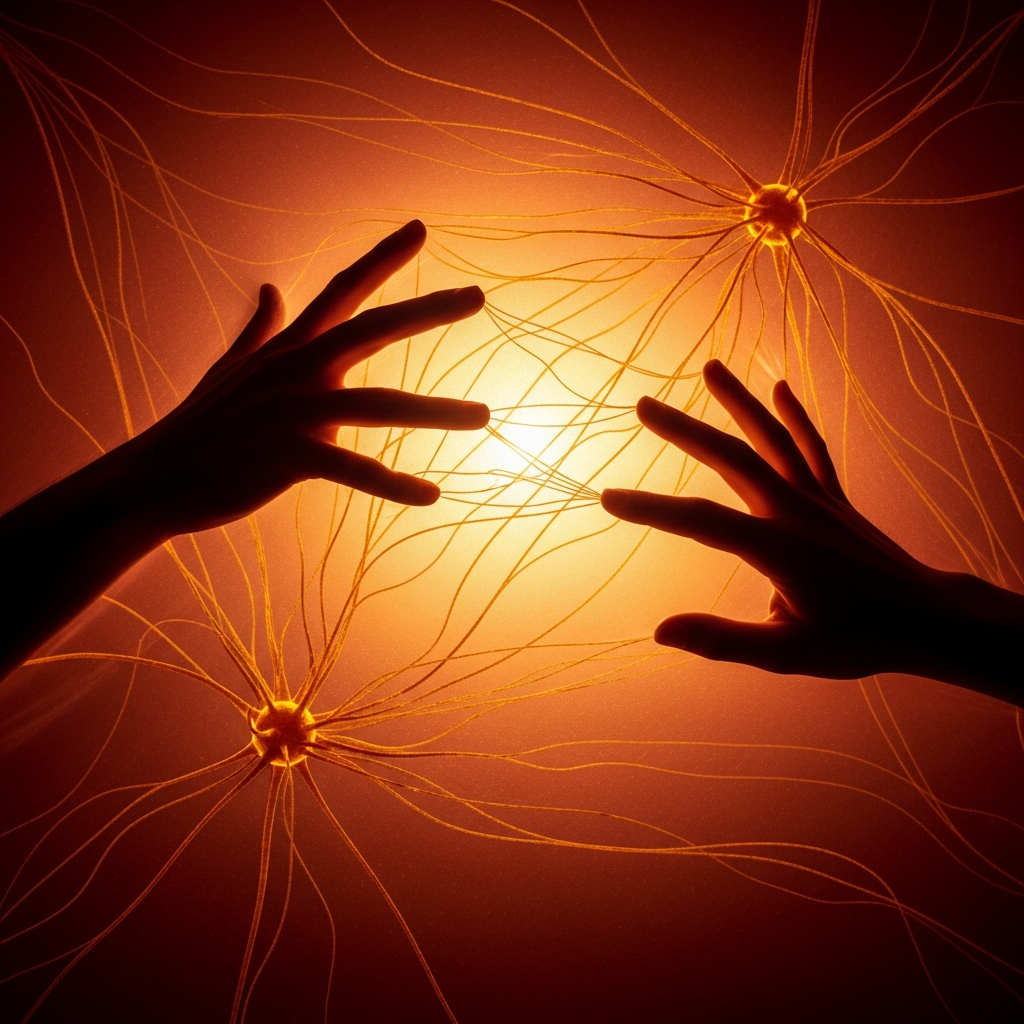
That slight tug in your chest when someone on screen winced in pain? That's not empathy in some vague, poetic sense. That's your visual cortex — the part of your brain that processes sight — secretly running a body map. A physical, organized, neurological map of someone else's body. Inside your own head. Right now.
What I Found That Genuinely Surprised Me
I came across new research published in Nature, and I have to be honest — I had to read the key finding twice. Scientists had participants watch simple movies of people moving, touching things, reacting. Nothing dramatic. Just ordinary human motion. And while they watched, researchers tracked what was happening across the entire brain.
Here's where it gets strange. The regions of the brain long assumed to only handle vision — regions we thought were purely about processing light and color and shape — were doing something else entirely. They were lighting up in patterns that matched the body. A hand on screen activated one region. A face activated another. A foot, another still. So far, so interesting, right?
But here's the part that stopped me cold: those patterns didn't just reflect the visual shape of a hand or a face. They matched the exact neural layout the brain uses when you physically feel a touch on your own hand or face. The same map. The same organization. Vision and touch, sharing the same hidden architecture.
As researcher Hedger put it: "The machinery the brain uses to process touch is baked into the visual system." Baked in. Not borrowed. Not improvised. Built in from the start.
Let Me Put This in Human Terms
Imagine your brain is like a house. For a long time, scientists thought the living room — the visual cortex — was just for watching TV. Incoming images, process them, done. But what this research reveals is that the living room also has a full sensory kitchen hidden behind the wall. And every time you watch someone reach for something, that kitchen quietly starts cooking.
Your brain isn't just registering what you see. It's translating what you see into what it would feel like to be that person. Automatically. Unconsciously. Every single time.
This is what neuroscientists call sensory integration — the blending of different senses into one unified experience. And what this research shows us is that integration runs far deeper than anyone previously thought. Seeing is, in a very real biological sense, a form of almost-feeling.
That Feeling You Had During the Movie Last Night? That Was Real
Think about the last time you flinched watching someone get hurt on screen. Or felt your stomach tighten when someone on a video call looked genuinely distressed. We've always explained this away as "just empathy" — as if empathy were some soft, unscientific thing. But what we're actually describing is a precise neurological event. Your visual system fired touch-processing circuits. Your brain built a temporary body map of another person inside your own nervous system.
That restless, slightly uncomfortable feeling you get watching someone struggle? That's not weakness. That's not over-sensitivity. That is your brain doing exactly what it was designed to do — reaching across the gap between two bodies and building a bridge made of neurons.
We are, at the most fundamental biological level, wired to feel each other.
Why This Changes More Than Just Neuroscience
Here's where this research opens doors I find genuinely exciting. The scientists behind this work believe these findings could reshape how we understand autism and sensory processing differences. For people who experience the world differently — where sensory signals don't integrate in typical ways — this hidden body map inside the visual system might work differently too. And now, crucially, researchers may be able to study that simply by having someone watch a movie. No stressful clinical tests. No uncomfortable procedures. Just watching.
That matters enormously. Reducing the stress of diagnosis, especially for children, could change everything about how early we catch these differences and how compassionately we respond to them.
There's also a ripple effect into technology. Engineers building brain-inspired AI have long tried to model human perception. But if human perception is fundamentally embodied — if seeing cannot be separated from almost-feeling — then any model that treats vision as purely visual is missing the most important part of what makes human perception human.
We Are Not Passive Observers of the World
This is the thing I keep coming back to. We walk around believing we observe life from a slight distance — watching, processing, deciding. But the biology says otherwise. Every face we see, every hand we watch reach for a coffee cup, every person we watch laugh on a screen — our brains are physically mapping those bodies onto our own. We are not watching the world. We are, in a very quiet and constant way, inhabiting it alongside everyone in it.
That's not a metaphor. That's a measurable neurological fact, now published in one of the most respected scientific journals on the planet.
The next time you feel moved by something you see — a stranger's kindness caught on camera, a child's face lighting up — know that your brain didn't just see it. Some part of you, hidden in the architecture of your visual system, reached out and almost touched it.
🧠 Brain Hack: The "Body Anchor" Reset
Because your visual system is constantly building body maps from everything you see, it means your nervous system is absorbing the emotional and physical states of everyone on your screen — all day long. Doomscrolling distress, frantic energy in a meeting, someone's visible anxiety on a call. You're not just watching it. You're partially running it in your own body.
Today, try this: After any screen-heavy period, spend 60 seconds doing what neuroscientists call a "body anchor." Place both hands flat on a physical surface — a desk, your thighs, a wall. Press gently. Focus on the pressure and temperature under your palms. This activates your actual somatosensory cortex — your real touch system — and gently overrides the ghost body maps your visual system has been accumulating. You're reminding your brain: this body, this surface, this moment. It works. And you can do it right now.
Scientists just discovered that the part of your brain you use to see someone's hand on screen is running the exact same neural map as when someone physically touches your own hand — meaning every time you watch a movie, your visual cortex is secretly moonlighting as a touch simulator.``` TITLE: Your Brain Is Lying to You Right Now — And It's Doing It Out of Love

