The Hook
Last night, you didn't just sleep. You ran a biological dishwasher inside your skull — and you probably cut the cycle short. That groggy, slightly foggy feeling you woke up with this morning? That's not tiredness. That's the smell of a drain that didn't fully clear.
I know that sounds dramatic. But I found something in the research coming out of the Medical University of South Carolina that genuinely stopped me in my tracks — and once I understood it, I couldn't look at my own sleep habits the same way again. Scientists have just confirmed the existence of a hidden lymphatic drainage system wrapped around the human brain. It runs most efficiently while you sleep. And when it fails, the consequences may include Alzheimer's disease.
We've been treating sleep like a luxury. It turns out it's the only time our brains take out the trash.
The Deep Dive
Here's what I noticed first: we've known for decades that the rest of the body has a lymphatic system — a network of tiny vessels that act like sewage pipes, flushing out cellular waste, dead proteins, and metabolic byproducts. Your liver, your kidneys, your lymph nodes — they're all part of this cleanup crew. But for a long time, scientists believed the brain was completely separate from this system. It was considered immunologically "privileged," meaning it operated behind a sealed wall — the blood-brain barrier — and handled its own affairs.
What I found surprising is how recently that assumption was overturned. In 2013, researchers at the University of Rochester, led by neuroscientist Maiken Nedergaard, discovered something called the glymphatic system — think of it as the brain's own version of lymphatic plumbing. Cerebrospinal fluid, the clear liquid that cushions your brain, gets pumped through channels surrounding blood vessels, flushing out toxic proteins. One of the most dangerous of these proteins is called amyloid-beta — the same sticky plaque that accumulates in the brains of Alzheimer's patients.
But here's where the new research from 2026 changes everything. Scientists at the Medical University of South Carolina have now mapped something even more specific: a hidden network of meningeal lymphatic vessels running alongside the middle meningeal artery — a major blood vessel that travels through the tough outer membrane wrapping your brain. These aren't theoretical. They photographed them. They tracked their drainage dynamics in real human tissue using advanced imaging. They are physically there, doing a job we didn't fully know about until now.
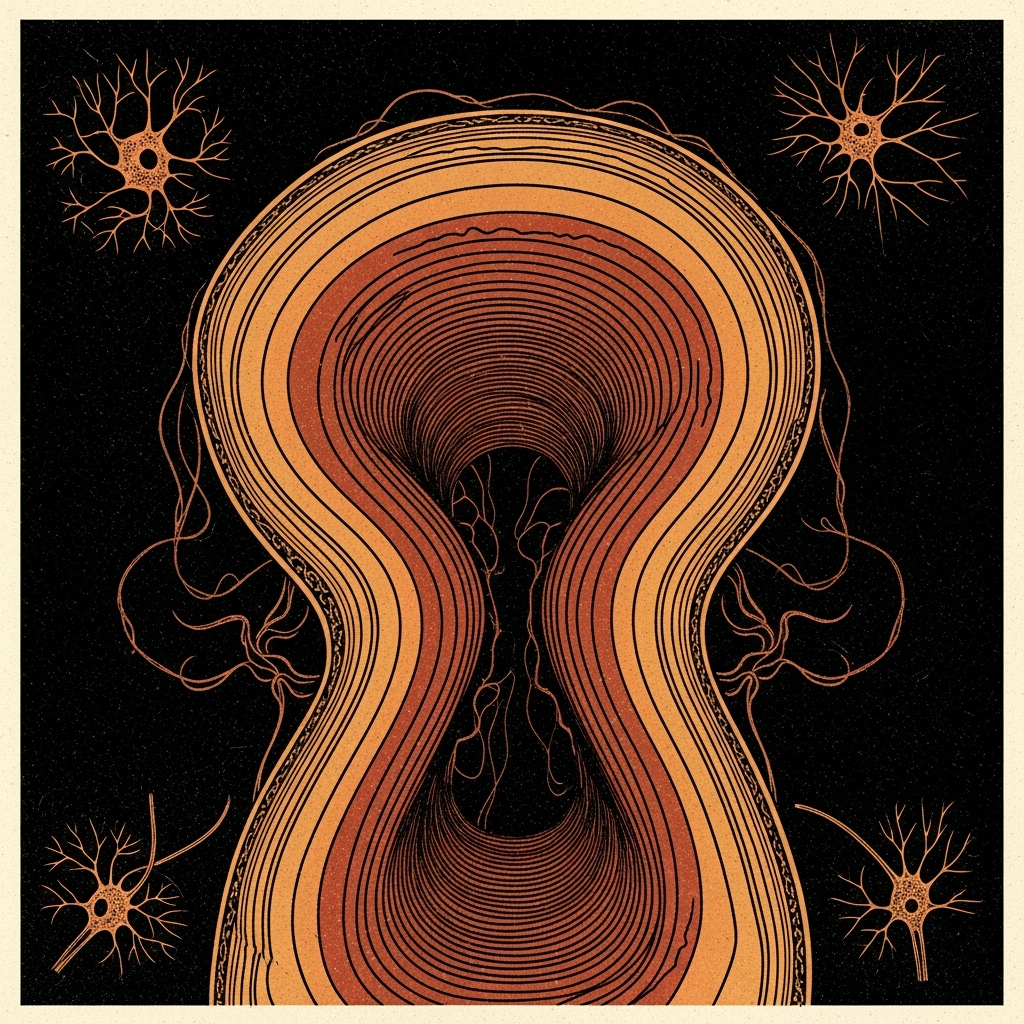
Think of it this way. Imagine your brain is a kitchen. The glymphatic system is the water running over the dishes. These newly confirmed meningeal lymphatic vessels are the actual drain — the pipes that carry the dirty water away from the sink entirely. Without the drain working properly, the water just sits there, getting colder and grimier. The dishes never really get clean.
And here's where it gets personal. That afternoon brain fog you felt around 3pm today — the one where reading the same sentence three times felt like an athletic achievement — that's not laziness. That's partly the consequence of a morning where your brain's drainage system didn't complete its job. Research on aging has shown that as we get older, these meningeal lymphatic vessels lose their structural integrity. They stiffen. They narrow. They drain less efficiently. In a study published in early 2025, researchers boosted lymphatic vessel function in old mice — and their memory improved. The pipes got cleaner. The brain worked better.
So what's actually being flushed? During the day, your neurons are firing constantly — processing information, managing emotions, making the thousand small decisions you think are logical but often aren't. All that activity generates metabolic waste. Amyloid-beta is one byproduct. Tau protein — another Alzheimer's-linked molecule — is another. Your brain produces these proteins the way a car engine produces exhaust. The glymphatic system and the meningeal lymphatics are your catalytic converter and your exhaust pipe combined. Research suggests this system operates continuously, but runs at significantly greater efficiency during deep, slow-wave sleep — the kind of sleep that takes about 90 minutes to reach, and that most of us cut short by staying up too late or waking up too early. The precise relationship between specific sleep stages and drainage efficiency in humans remains an active area of investigation, but the evidence pointing toward deep sleep as the brain's prime cleaning window is compelling.
We've been asking "how do I sleep better?" when the more urgent question is: "what happens to my brain when I don't?"
The answer, increasingly, looks like this: the toxic proteins build up. Slowly, over years and decades, the drain gets clogged. And the brain that once processed the world with clarity starts to lose its signal. Alzheimer's may not be a disease that strikes randomly. It may be, in significant part, a disease of accumulated uncleaned waste — of nights cut short and drains left blocked.
Why It Matters
I want us to sit with the weight of this for a moment, because I think we've been handed something genuinely important. For decades, Alzheimer's research focused almost entirely on the amyloid plaques themselves — trying to dissolve them, block them, prevent them from forming. Many of those drug trials failed. What this new understanding suggests is that we may have been focused on the mess while ignoring the broken drain.
If the meningeal lymphatic system is the critical pathway for clearing these toxic proteins, then protecting and supporting that system becomes one of the most important things we can do for long-term brain health. And the primary way we support it? Sleep. Specifically, consistent, sufficient, uninterrupted deep sleep — the kind your brain uses to run its nightly cleaning cycle.
This also reframes how we think about the small daily choices that compound over time. Every late night. Every alarm set an hour too early. Every sleep disrupted by a phone notification. These aren't just tiredness the next day. They are, potentially, incremental failures of the brain's waste removal system — tiny clogs in a drain that, over a lifetime, may have enormous consequences.
We are not, as a culture, taking sleep seriously enough. And now we have the biological plumbing to explain exactly why we should.
Brain Hack — The 90-Minute Sleep Window: Tonight, count back 7.5 hours from when you need to wake up. Set that as your lights-out time. Why 7.5? That's five complete 90-minute sleep cycles — the unit your brain uses to reach and repeat deep slow-wave sleep, the phase where your brain's drainage system runs at peak efficiency. You're not just getting more sleep. You're giving your brain's drain enough time to fully clear. Do this for three nights and notice whether your 3pm fog lifts. Your brain isn't broken. It just needs the full cycle to clean itself.
Scientists have confirmed that your brain has a hidden drainage system running along a major artery in its outer membrane — and it operates most powerfully during deep sleep, flushing out the toxic proteins linked to Alzheimer's, meaning every hour of sleep you skip may be leaving your brain a little less clean than it was the night before.
References
- Iliff J, Nedergaard M, et al. (2013). A paravascular pathway facilitates CSF flow through the brain parenchyma. Science. https://en.wikipedia.org/wiki/Glymphatic_system
- Topol E. (2024). Our Sleep, Brain Aging, and Waste Clearance. Ground Truths / Substack. https://erictopol.substack.com/p/our-sleep-brain-aging-and-waste-clearance
- SciTechDaily. (2025). Scientists Discover a New Cleanup Hub Inside the Human Brain. https://scitechdaily.com/scientists-discover-a-new-cleanup-hub-inside-the-human-brain/