The Hook
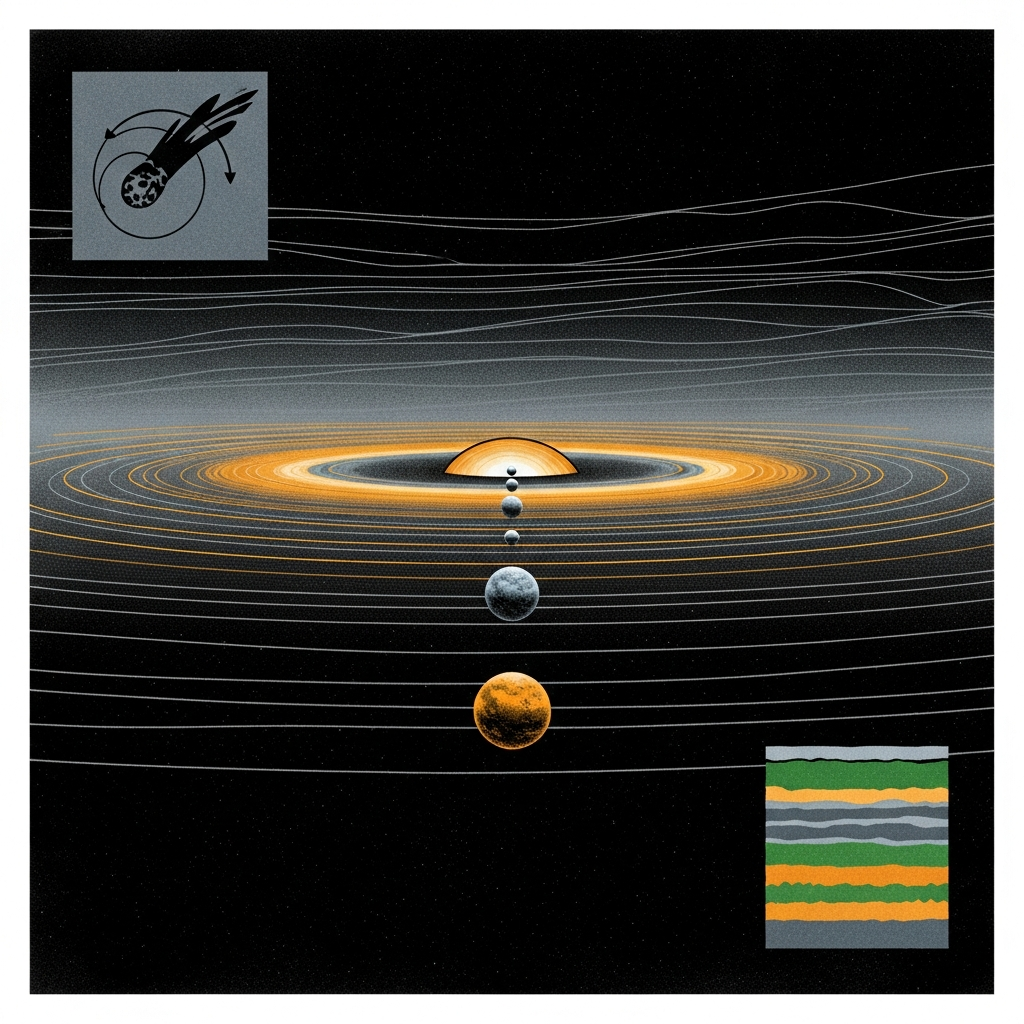
4.6 billion years ago, a disk of gas and dust collapsed around a newborn star. Gravity pulled chunks of rock and ice into rough orbits, sweeping the same flat plane like grooves worn into a vinyl record. Over millions of years, those chunks grew into worlds — Mercury baking at 430 degrees Celsius, Saturn draped in rings of frozen water, Neptune spinning in perpetual darkness 4.5 billion kilometers from the warmth that made it. Each planet carved its own lane, its own speed, its own silence. They have never touched. They have never aligned. The solar system is not a parade. It is a vast, lonely scatter of worlds separated by distances so enormous that if you shrank the Sun to a grapefruit, Neptune would sit nearly a kilometer away.
Now zoom in. It is 4:47 a.m. on April 19, 2026. A woman named Priya stands barefoot on the rooftop of her apartment building in Nagpur, India, a cup of chai cooling in her hands. The city hums below her. She faces east, where the sky has turned the particular shade of blue that exists for only twelve minutes before sunrise swallows it. And there, low on the horizon, she sees them — four points of light clustered together like a handful of spilled salt. Mercury. Mars. Saturn. And Neptune, invisible to her naked eye but present, lurking 4.3 billion kilometers behind the others. She thinks: the planets are aligned. She feels something ancient stir in her chest.
She is wrong about the alignment. But what she feels is entirely real.
The Deep Dive
Here is what is actually happening above Priya's rooftop. The solar system formed in a flat disk, which means all the planets orbit the Sun along roughly the same plane — like runners on a circular track, never stacked on top of each other, never truly side by side. From Earth, we see this plane projected across the sky as a line called the ecliptic, the same invisible highway the Sun traces across the sky each day. Every planet, every comet, every wandering rock stays close to this line. So when multiple planets happen to occupy the same short stretch of that highway at the same time, they appear bunched together from our vantage point. It looks organized. It looks intentional. It is neither.
Think of it this way: imagine standing at one end of a very long, straight road lined with telephone poles. From your position, the poles seem to cluster together, nearly touching. Walk fifty meters to the side, and they spread apart into their true spacing. Priya's rooftop is the end of that road. The "parade" only exists because she is standing in exactly the right place — on a small rock orbiting a medium star, peering along the flat disk of her own solar system.
In mid-April 2026, Mercury sits roughly 155 million kilometers from Earth. Mars lurks around 290 million kilometers away. Saturn orbits at approximately 1.5 billion kilometers. And Neptune, that cold blue giant 17 times the mass of Earth, hangs at 4.3 billion kilometers — so distant that sunlight takes four hours to reach it. These four worlds are not close to each other in any meaningful physical sense. Mercury and Neptune are separated by a gap that would take a spacecraft launched today more than a decade to cross. Yet in Priya's sky, they fit within a patch of horizon she could cover with her outstretched hand.
The window to see them is narrow. Between April 16 and 23, 2026, with the strongest grouping around April 18 to 20, observers in India's central and southern regions have a particularly good viewing angle — better than most high northern latitudes, where the ecliptic rides even lower on the horizon. The prescription is precise: look east, 30 to 45 minutes before local sunrise. Mercury and Mars punch bright enough for the naked eye. Saturn glows faintly if the horizon is clean. Neptune requires a telescope, its blue-gray disk tiny and remote, a world discovered not by sight but by mathematics — both the French mathematician Urbain Le Verrier and the British mathematician John Couch Adams independently predicted its position in the 1840s using only gravitational equations, and when telescopes were pointed at Le Verrier's predicted coordinates in 1846, Neptune appeared within one degree of where the calculations said it had to be. Neptune had been seen before and mistaken for a star. The solar system was hiding its outermost giant in plain sight for decades.
There is also a comet sharing the pre-dawn sky this week. Comet C/2025 R3, known as PanSTARRS, reaches its closest point to the Sun on April 19 — the same morning the planetary grouping peaks — and swings nearest to Earth on April 27. It may be visible to the naked eye, though binoculars will sharpen it into something with a proper tail. Some astronomers suspect it originates from the Oort Cloud, a vast spherical shell of frozen debris that wraps around the solar system at distances up to 100,000 times the Earth-Sun distance. The comet has spent millions of years out there in the dark, and this week it passes through our inner neighborhood for possibly the first and only time in human history.
None of this is alignment. All of it is perspective.
Why It Matters
Here is the vertigo: the illusion Priya sees from her rooftop is itself a product of deep time. The ecliptic exists because 4.6 billion years ago, a collapsing cloud of gas inherited a slight rotation, and that rotation flattened everything into a disk. Every planet, every moon, every comet tail she will ever see low on the horizon is a direct consequence of that ancient spin. The flat solar system is not an accident. It is angular momentum preserved across billions of years, written into the sky every single morning.
And the fact that we can stand on one of those orbiting rocks, look along the plane of our own solar system, and feel the planets clustering toward us — that is not nothing. The illusion is made possible by geometry that took 4.6 billion years to arrange. Priya is not watching a parade. She is watching the edge of a disk, peering down the barrel of her own cosmic address. The planets are not aligned. She is. Every human who has ever craned their neck toward a pre-dawn sky, every Babylonian astronomer who scratched observations into clay tablets, every child who has pressed their face against a telescope eyepiece — all of them standing on the same flat platform, looking outward along the same ancient plane.
The solar system does not perform for us. But sometimes, for twelve minutes in the blue hour before sunrise, it looks exactly like it does.
Neptune was never "discovered" in the traditional sense — it was mathematically conjured into existence in 1846, independently predicted by both French mathematician Urbain Le Verrier and British mathematician John Couch Adams. When astronomers pointed their telescopes at the predicted coordinates, there it was, exactly where the equations said it had to be: a world found by pure thought before a single human eye ever consciously recognized it.
References
- Lyttleton, R.A. (1960). The discovery of Neptune. Vistas in Astronomy, 3. https://ui.adsabs.harvard.edu/abs/1960VA......3...25L
- Encyclopedia.com. Le Verrier, Adams, and the Mathematical Discovery of Neptune. https://www.encyclopedia.com/science/encyclopedias-almanacs-transcripts-and-maps/leverrier-adams-and-mathematical-discovery-neptune
- Space.com (2025). Will Comet C/2025 R3 PanSTARRS be the great comet of 2026? https://www.space.com/astronomy/comets/will-comet-c-2025-r3-panstarrs-be-the-great-comet-of-2026