The Hook
Thirteen billion years ago, the universe exhaled. Clouds of hydrogen and helium — each one wider than a thousand solar systems — collapsed inward under their own gravity, igniting into the first stars. The process was violent, thermonuclear, irreversible. Stars are born when gravity wins so completely that the core catches fire and fuses atoms together at 15 million degrees Celsius. Planets are born differently: grain by grain, pebble by pebble, boulder by boulder, accreting slowly from the leftover rubble of a stellar nursery like a snowball rolling across an infinite cosmic plain.
These are two fundamentally different stories of creation. One is top-down — a vast cloud collapses and fragments into something stellar. The other is bottom-up — dust whispers to dust until something massive emerges from almost nothing. For centuries, astronomers assumed the universe kept these two stories neatly separated. Stars here. Planets there. A clean border somewhere in between.
Now zoom in. Past the Milky Way's spiral arms. Past the glowing nurseries of Cygnus, the swan constellation stretching across our northern summer sky. Down to a single star system, 29 Cygni, sitting roughly 170 light-years from the patch of ground beneath your feet. Orbiting that star is an object called 29 Cygni b — and it has just shattered the border entirely.
The Deep Dive
29 Cygni b weighs approximately 15 times the mass of Jupiter. To feel the scale of that: Jupiter itself is so enormous that all the other planets in our solar system could fit inside it by volume with room to spare. Now multiply that by 15. The object is a colossus — so massive that for decades, astronomers would have reflexively filed it under a category called a "brown dwarf," a kind of object that never accumulated quite enough mass to ignite the sustained hydrogen fusion that powers true stars.
Brown dwarfs occupy the uncomfortable middle ground between planets and stars. They are too big to be planets by traditional count, too small to be stars. Importantly, they are not entirely "failed" in nuclear terms — objects above roughly 13 Jupiter masses can fuse deuterium, a heavier form of hydrogen, and some fuse lithium as well. But they cannot sustain the hydrogen fusion that defines a true star, which requires around 80 Jupiter masses. Astronomers drew the deuterium-burning line at roughly 13 Jupiter masses as a convenient boundary: below that, a planet; above that, a brown dwarf or stellar fragment. 29 Cygni b, at 15 Jupiter masses, sits just above that line. By the old rulebook, it should be classified as a brown dwarf. Case closed.
Except the James Webb Space Telescope looked closer, and the rulebook caught fire.
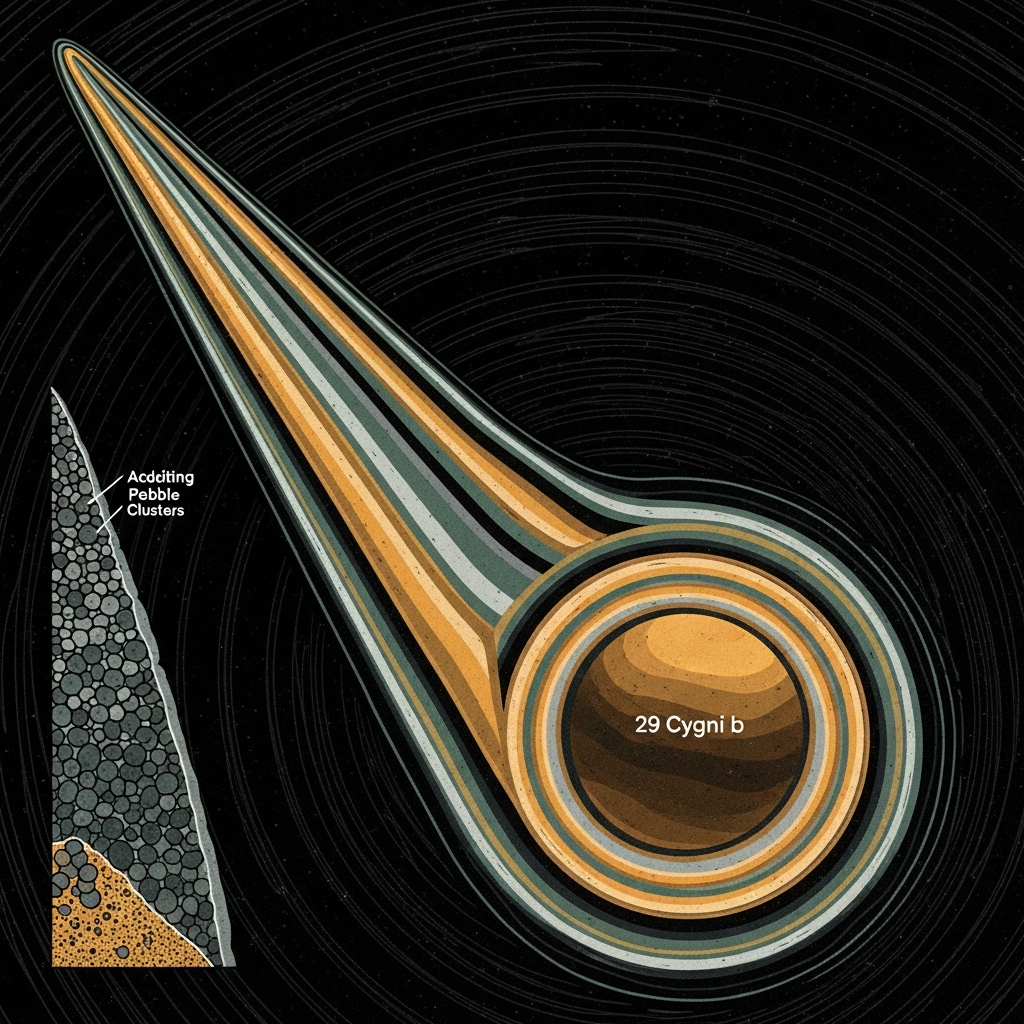
An international team of astronomers published findings from Webb's meticulous study of 29 Cygni b. They weren't just measuring its mass. They were reading its biography — specifically, how it formed. And the answer, written in the object's composition and orbital architecture, was unambiguous: 29 Cygni b grew from the bottom up. It accreted within a protoplanetary disc, the same swirling pancake of gas and dust that built Earth, Mars, and every other planet in systems like ours. Grain by grain. Pebble by pebble. It is, in every meaningful sense of the word, a planet.
Here is the key insight, explained simply: imagine two ways to make a snowman. You could scoop up a massive pile of snow and carve it down into shape — that's how stars form, top-down from collapsing clouds. Or you could roll a small snowball across a field, letting it grow by picking up more snow as it travels — that's how planets form, bottom-up through accretion. 29 Cygni b is the second snowman. It just kept rolling until it became something almost unimaginably large.
Webb detected this by examining the object's chemical fingerprint and the geometry of its orbit around its host star. Objects that form through stellar collapse — the top-down method — tend to have different chemical signatures and orbital characteristics than objects that grow through disc accretion. 29 Cygni b matched the planet-formation profile with striking clarity. Its orbit, its composition, the way it sits within the architecture of its system — all of it pointed toward a planetary origin story, not a stellar one.
This forces astronomers to confront an uncomfortable truth: the 13-Jupiter-mass boundary they have used for decades is not a physical law. It is a guideline that nature has now cheerfully ignored. Formation process, not mass alone, may be what truly distinguishes a planet from a brown dwarf or a star. And if that's true, the universe almost certainly harbors many more 29 Cygni b-style objects — enormous, planet-formed worlds hiding above the old boundary line, misclassified for generations.
Think about what that means for the search for life. If planetary formation can produce objects 15 times Jupiter's mass, what else can it produce that we haven't yet recognized? What other worlds have we mislabeled, dismissed, or simply failed to look at because they didn't fit the categories we invented?
Why It Matters
Webb is doing something profound here that goes beyond one object in one star system. It is handing us a new lens — one precise enough to read not just what something is, but how it came to be. Mass is a measurement. Formation history is a story. And stories carry more truth.
The boundary between planets and stars was always a human construct, a line we drew through the cosmos for our own convenience. Nature never agreed to it. 29 Cygni b existed long before we had a category for it, orbiting its star in patient indifference to our taxonomies. It formed 170 light-years away from the patch of ocean where the first complex life stirred on Earth, growing grain by grain while our planet was still assembling itself from its own disc of debris.
Now zoom back out. Every star you can see on a clear night is surrounded by the ghost of a protoplanetary disc — the ancient construction site where worlds were built. Some of those discs built objects we recognize. Some built things like 29 Cygni b, which straddle the definitions we thought were permanent. The galaxy is not organized by our textbooks. It is organized by gravity, chemistry, time, and a bottom-up patience that can turn dust into something 15 times the size of Jupiter.
We are made of the same dust. The same bottom-up process that built 29 Cygni b built the carbon in your bones and the iron in your blood. We are, all of us — humans, planets, and misclassified giants alike — products of accretion. Of small things finding each other across vast distances and becoming something larger than any one of them could have imagined.
The border between planets and stars just moved. And the universe is larger, stranger, and more generously built than we knew yesterday.
29 Cygni b is 15 times the mass of Jupiter — large enough that astronomers classified it as a brown dwarf for decades — but Webb just proved it grew grain by grain like a planet, meaning the line between worlds and stars may not be about mass at all.
Coordinates: On any clear night, face the constellation Cygnus — the Northern Cross, rising in the northeast after midnight in summer. The star 29 Cygni sits within that glowing river of the Milky Way, roughly at RA 21h 06m, Dec +42°. You cannot see 29 Cygni b with the naked eye, but you can stand beneath that exact patch of sky and know that 170 light-years above your upturned face, a world too large for our old definitions is completing another silent orbit around its star — a planet that refused to know its place.
References
- ESA/Webb (2026). Webb redefines the dividing line between planets and stars. ESA Webb News. https://es